


- Home
 System On Module
- Qualcomm Snapdragon 600
- VAR-SOM-SD600 Qualcomm Snapdragon 600
VAR-SOM-SD600
Qualcomm Snapdragon 600
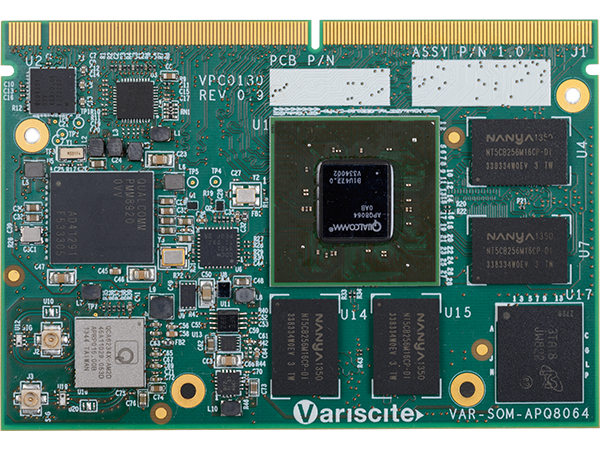
The VAR-SOM-SD600 supports the Qualcomm Snapdragon™ 600 (APQ8064) 1.7 GHz quad Krait™ processor. With a staggering 22,400 DMIPS processing power and highly optimized power consumption Variscite have successfully delivered a premier commercial processor into the embedded arena. High-resolution displays, advanced multimedia support and broad network compatibility are just some of the features that ensure a richer experience in various embedded segments and applications.



Highlights

CPU
Up to 1.7GHz Qualcomm Snapdragon™ 600 (APQ8064)

Multimedia
1080p60 H.264 Decode, 1080p60 H.264 Encode

Display
HDMI, LVDS, DSI

Certified Wi-Fi/Bluetooth
802.11 b/g/n + optional MIMO

Memory
2048 MB DDR3

Ethernet
10/100/1000 Mbps

Temperature range
-20-85 C

Support
Supporting you every step of the way - from ideation to launch and beyond.
Free and prompt support directly from Variscite’s R&D experts.
Quick Links


Specifications
CPU Name
Qualcomm Snapdragon™ 600 (APQ8064)
CPU Type
Krait™ 300
CPU Cores
4 cores
CPU Clock (Max)
1.7 GHz
RAM
2048 MB DDR3
eMMC
64 GB eMMC
Multimedia
2D/3D Graphics Acceleration
Adreno 320
Video Encode / Decode
1080p60 H.264 Decode, 1080p60 H.264 Encode
Camera Interfaces
2x CSI
Display
HDMI
v1.4a 1920 x 1080
LVDS
2048 x 1536 24-bit
DSI
2048 x 1536 24-bit
Audio
Headphone driver
Yes
Microphone
Analog / Digital
Digital audio serial interface
I25
Line In/Out
Yes
Connectivity
SD / MMC
x2
USB Host / Device
USB 2.0 : 3x Host, 1x OTG
UART
x3, up to 4 Mbps
I2C
up to x6
SPI
up to x6
S-ATA
SATA I interface, 1.5 Gbps
RTC
On SoM
PCI-Express
Gen 2.0
Networking
Ethernet
10/100/1000 Mbps
Wi-Fi
802.11 b/g/n + optional MIMO
Bluetooth
4.0
Linux
Yes
Android
Yes
Mechanical Specifications
SoM Interface
MXM 3.0, 314 pins
Dimensions (W x L)
82 x 56 mm
Electronic Specifications
Supply voltage
3 - 4.5 V
Digital I/O voltage
1.8 V
Environmental Specifications
Commercial temperature
0 to 70°C
Extended temperature
-20 to 70°C
Industrial temperature
-20 to 85°C

VAR-SOM-SD600_1700C_[xxxx]R_[xxx]G_[EC]_[AC]_[WB]_[x]T
[xxx]R:
1024 MB : 1024R, 2048 MB : 2048R
[xxx]N:
4 GB : 4G, 8 GB : 8G, 16 GB : 16G, 32 GB : 32G, 64 GB : 64G
[EC]:
10/100/1000Mbps Ethernet PHY
[AC]:
Audio Codec
[WB]:
Wi-Fi 802.11 b/g/n + Bluetooth 4.0
[x]T:
C : 0 to 70°C, E : -20 to 70°C, I : -20 to 85°C


Our Long-Standing Partnerships
Our close partnerships with leading technology vendors provide our customers with early access to the latest advanced solutions, ensuring your projects begin with a solid and future-ready foundation.


Get Your Custom Quote
Fill out the details below and one of our
representatives will contact you shortly
representatives will contact you shortly

Why Variscite?

Quality
In-house manufacturing with comprehensive quality control - certified to ISO9001 and ISO13485 medical standards.

Pin2Pin
Our Pin2Pin product families maximize scalability and enable seamless migration to future technologies without redesigning the carrier board.

Longevity
15-year guaranteed hardware availability, backed by continuous software updates and support.

Customizability
Configure your system with precision and flexibility - select only the features you need and reduce costs.
Updates

 28.10.2026
 Software releases
Stay current with software updates – Keep your Variscite SoMs performing at their best with our latest software releases.
Debian Bookworm 6.6.y_24.12-v1.2 for i.MX 8M Nano modules: VAR-SOM-MX8M-NANO
Debian Bookworm 6.6.y_24.12-v1.2 for i.MX 8M Nano modules: VAR-SOM-MX8M-NANO

Newsroom

Variscite is bringing its System on Module (SoM) portfolio into the CELUS Design Platform, giving engineers a faster way to move from initial concept to a production-ready design, with much of the manual component-selection work automated away. The integration pairs Variscite’s hardware with CELUS’ AI Design Assistant, aimed at cutting time out of the early, slow-moving stages of hardware design.
Blog

Pierluigi Passaro, Variscite’s R&D expert, introduces the VAR-SOM-6UL – a highly flexible module offering a wide range of interfaces and connectivity options in a design optimized for power, size, and cost. As a member of Variscite’s VAR-SOM Pin2Pin family, it allows developers to scale performance and features without changing the carrier board design.
