Global component shortages are putting embedded projects under pressure. As a leading global System on Modules (SoMs) developer and manufacturer, we keep our customers’ development timelines on track by applying a supply chain strategy built on buffered inventories, in-house production, established relationships with multiple suppliers, and more than two decades of operational experience.
As AI-driven demand accelerated through 2025, memory chip shortages developed as semiconductor manufacturers shifted capacity to large-volume buyers, leaving many sectors, including medical, industrial, edge/IoT, and robotics poorly served. Climbing prices and lengthening lead times, exacerbated by knock-on effects across other SoM components, have created two clear pressure points. SoM vendors relying on outsourced manufacturing have limited flexibility when availability drops, leaving customers facing the same delays. Separately, product developers who chose chip-down architectures over SoM-based designs must procure components on their own. Those buying in smaller quantities are routinely pushed down supplier priority lists, and in many cases cannot get supply at all.
In-House Production, Stable Supply
While conditions across the industry have tightened, Variscite’s approach to supply chain management has centered on well-stocked component inventories and an integrated production model that offsets the availability pressures affecting other SoM vendors. More than 20 years of industry presence have allowed the company to build direct relationships with various component suppliers, giving it both the volume leverage and the sourcing flexibility to draw from more than one source. Its NXP Platinum Partner status adds a further layer of advantage, providing procurement priority and first access to new NXP hardware ahead of the wider market.
Complete production control is equally central to Variscite’s resilience. Managing the full manufacturing process in-house means Variscite can also offer customers broad configuration options, among them selectable memory options with multiple RAM variants per module. When a customer’s target combination of processor, performance interfaces, and price is unavailable, Variscite can propose a validated alternative, allowing development projects to continue without waiting on parts. All in-house production carries ISO 9001, ISO 13485, and ISO 27001 certification, covering quality management, medical-grade manufacturing standards, and information security, so supply resilience never undermines quality.
20 Years of Proactive Supply Chain Management
This preparedness is not a recent development. When COVID-related disruptions hit global supply chains, Variscite responded by growing its production and warehousing by 25 percent, sustaining delivery timelines across its full SoM portfolio at a time when many manufacturers were falling behind. The infrastructure built during that period remains fully operational, and when the present component crisis began, Variscite was already equipped to handle it.
“We have always believed in investing ahead of the problem. We maintain buffered component inventories, invest in our in-house production facilities, and work directly with multiple key suppliers – so that when industry-wide shortages hit, our customers enjoy manageable lead times and stable supply, rather than watching their projects grind to a halt,” said Ofer Austerlitz, VP Business Development and Sales at Variscite. “As a result, our existing customers can secure their development and production schedules, while customers currently experiencing supply difficulties with other vendors have a ready alternative in Variscite’s SoM portfolio.”
The outcome for Variscite customers is clear: dependable shipping windows and supply continuity at a time when much of the market cannot deliver either. Variscite’s 15-year supply commitment takes on the long-term sourcing risk that would otherwise sit with the customer’s product team – a level of continuity that vendors without in-house manufacturing struggle to replicate.
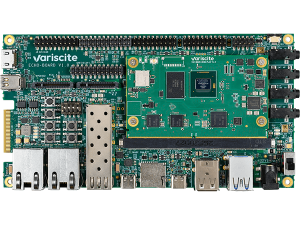
Variscite SMARC-compliant i.MX 8M Plus SoM with starter kit
Your SMARC Shortage Solved
For engineers whose current designs are built around SMARC-standard modules from vendors facing supply difficulties, Variscite’s portfolio presents a direct migration path. The SMARC specification defines a common electrical and mechanical interface, so moving to a Variscite SMARC module requires no carrier board modifications – minimizing transition risk and keeping timelines short. The portfolio currently includes an NXP i.MX 8M Plus-based module with quad-core processing and integrated AI/ML acceleration, with an i.MX 95-based module, featuring a six-core architecture and advanced edge AI capabilities, coming soon. Both modules include an on-SoM TPM for hardware-level security out of the box.
If your current vendor’s supply situation is affecting your schedule, contact us to explore your options.


 Join RSS Feed


As AI-driven demand accelerated through 2025, memory chip shortages developed as semiconductor manufacturers shifted capacity to large-volume buyers, leaving many sectors, including medical, industrial, edge/IoT, and robotics poorly served. Climbing prices and lengthening lead times, exacerbated by knock-on effects across other SoM components, have created two clear pressure points. SoM vendors relying on outsourced manufacturing have limited flexibility when availability drops, leaving customers facing the same delays. Separately, product developers who chose chip-down architectures over SoM-based designs must procure components on their own. Those buying in smaller quantities are routinely pushed down supplier priority lists, and in many cases cannot get supply at all.